
Project Snapshot
Product: Veteran Portal
Scope
UX Strategy, Service Design, Information Architecture, UI Design, Workflow Redesign
Environment
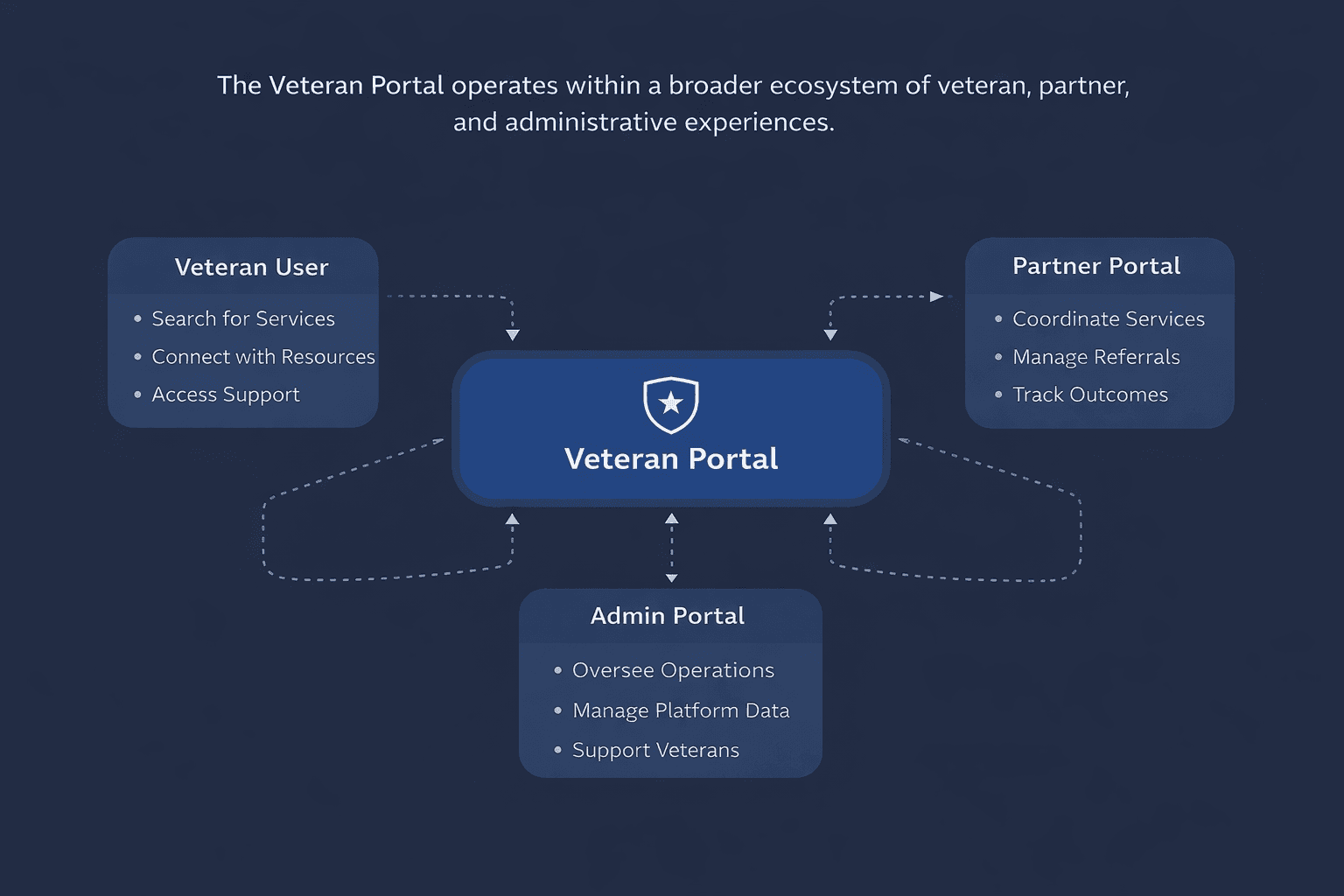
Multi-portal SaaS ecosystem supporting veterans, partners, and administrators
Primary Goal
Make it easier for veterans to navigate services, complete key actions, and engage with support resources
Team Impact
Led UX across an 8-person cross-functional team, aligning design, product, and engineering to deliver a unified platform experience.
My Role & Leadership
UX/UI Design Manager, CX Director
Partnered closely with product and engineering leadership to align UX strategy with platform constraints and delivery priorities.
Operated across UX strategy, research synthesis, information architecture, and interface design while leading cross-functional alignment across product and engineering.
Tools: Figma, Miro, Jira, Confluence, Slack, Google Suite

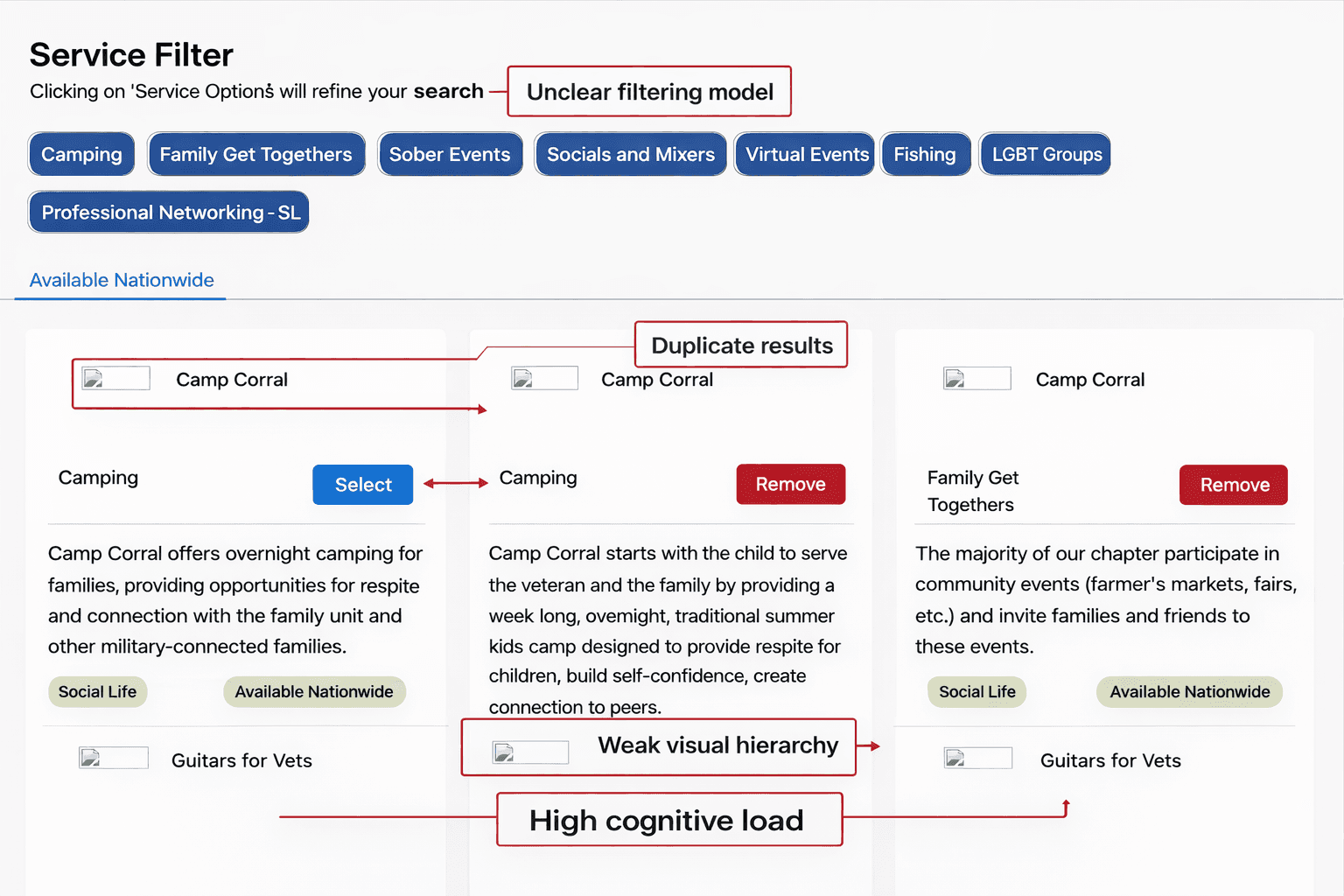
Where the experience broke down
The Challenge
A fragmented experience was making support harder to access
This was not a retail or marketing experience where friction simply reduces conversion. The platform supported veterans navigating real needs, often across complex life circumstances. When users encountered unclear navigation, inconsistent workflows, or unnecessary effort, the consequence was not just frustration. It risked disengagement at moments when support needed to feel accessible, trustworthy, and immediate.
From a UX and human factors perspective, the challenge was to reduce cognitive load, improve wayfinding, and create a clearer path from need to action.
My Role: Leading UX across strategy, structure, and execution
I led the UX effort for the Veteran Portal redesign as part of a broader platform transformation. My role included research synthesis, workflow analysis, information architecture, experience strategy, interface design, and developer handoff. I also worked cross-functionally with stakeholders to align UX decisions with service goals, technical constraints, and the realities of an evolving platform ecosystem.
This was not a narrow design assignment. It required system-level thinking, prioritization under ambiguity, and the ability to translate complex needs into a clearer experience architecture.
Approach grounded in human factors, cognitive load reduction, and service design principles.
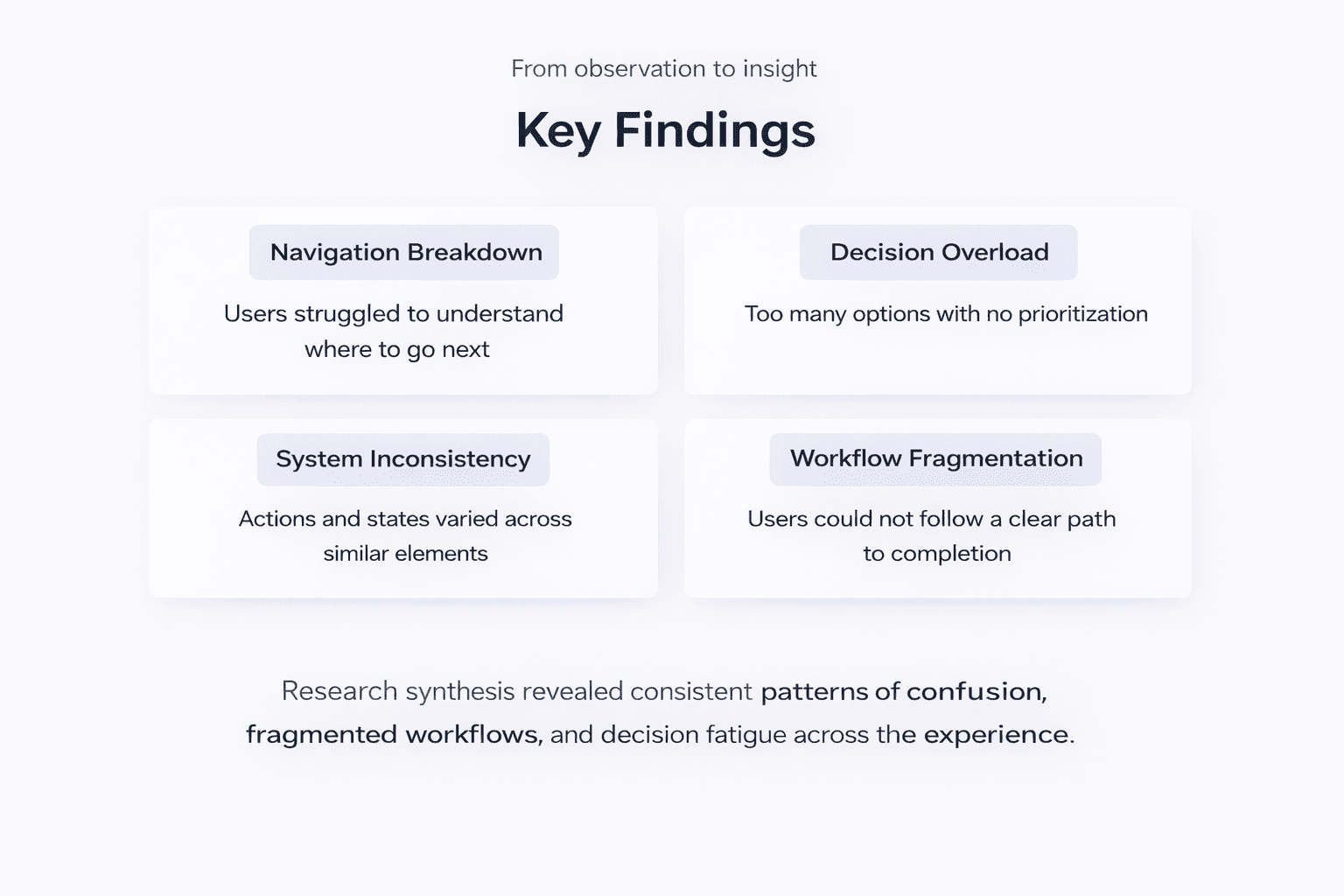
Insights derived from workflow analysis, heuristic evaluation,
and user behavior patterns.
Discovery and Diagnosis
Understanding where the experience was breaking down
To define the redesign strategy, I examined the portal through multiple lenses: user friction, workflow complexity, information clarity, and ecosystem alignment. I reviewed existing journeys, analyzed interaction patterns, and identified where the experience was failing to support user momentum.
This work revealed a pattern that is common in service ecosystems: the interface reflected internal system structure more clearly than it reflected user goals. Veterans were often required to navigate the platform in ways that made sense organizationally, but not experientially.
Inconsistent navigation and labeling
Unclear pathways to key services
Fragmented workflow structure
Excess cognitive load in critical moments
Weak alignment between user goals and system logic
Key Findings
The redesign focused on reducing friction in five core areas
01. Navigation clarity
Users needed clearer orientation and stronger wayfinding across the portal.
02. Information architecture
Content and actions were not organized around veteran priorities.
03. Workflow consistency
Experiences varied in structure and interaction patterns, creating unnecessary learning cost.
04. Cognitive load
Too many decisions, unclear labels, and fragmented paths made simple tasks harder than they should be.
05. Ecosystem disconnect
The Veteran Portal needed to work as part of a larger service system, not as an isolated interface.
Strategy
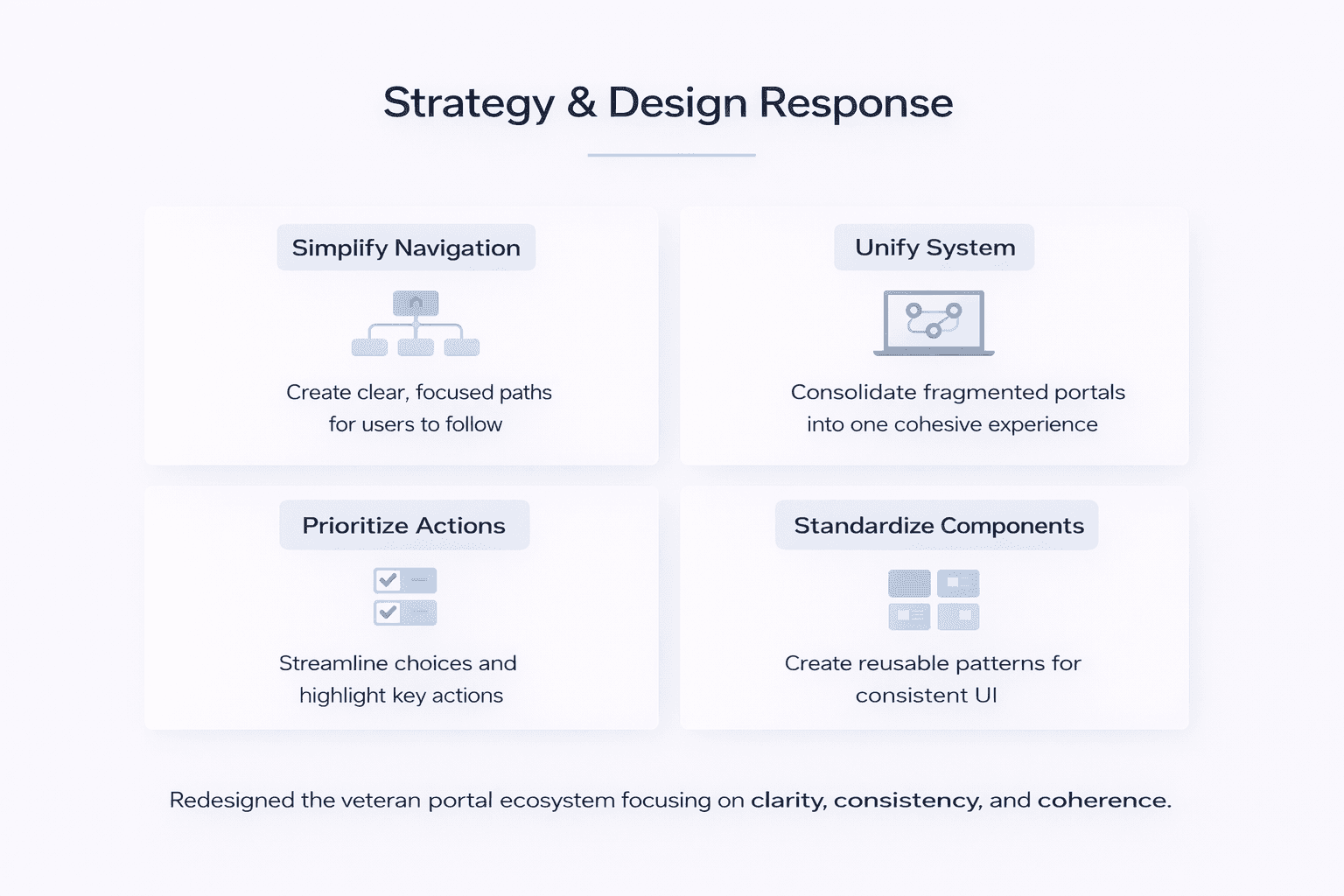
Reframe the portal around user goals, not internal structure
The redesign strategy centered on a simple but important shift: move from a system-centered experience to a user-centered one. Instead of asking veterans to adapt to the platform’s internal logic, the platform needed to better support how veterans actually seek help, understand options, and take action.
This meant simplifying navigation, restructuring content around user needs, improving workflow continuity, and creating a more coherent interaction model across the experience.
Simplify how users orient and move
Prioritize the most important actions
Reduce decision fatigue
Build consistency across flows
Align the portal with the broader service ecosystem
Design Response
Turning complexity into a clearer, more usable experience
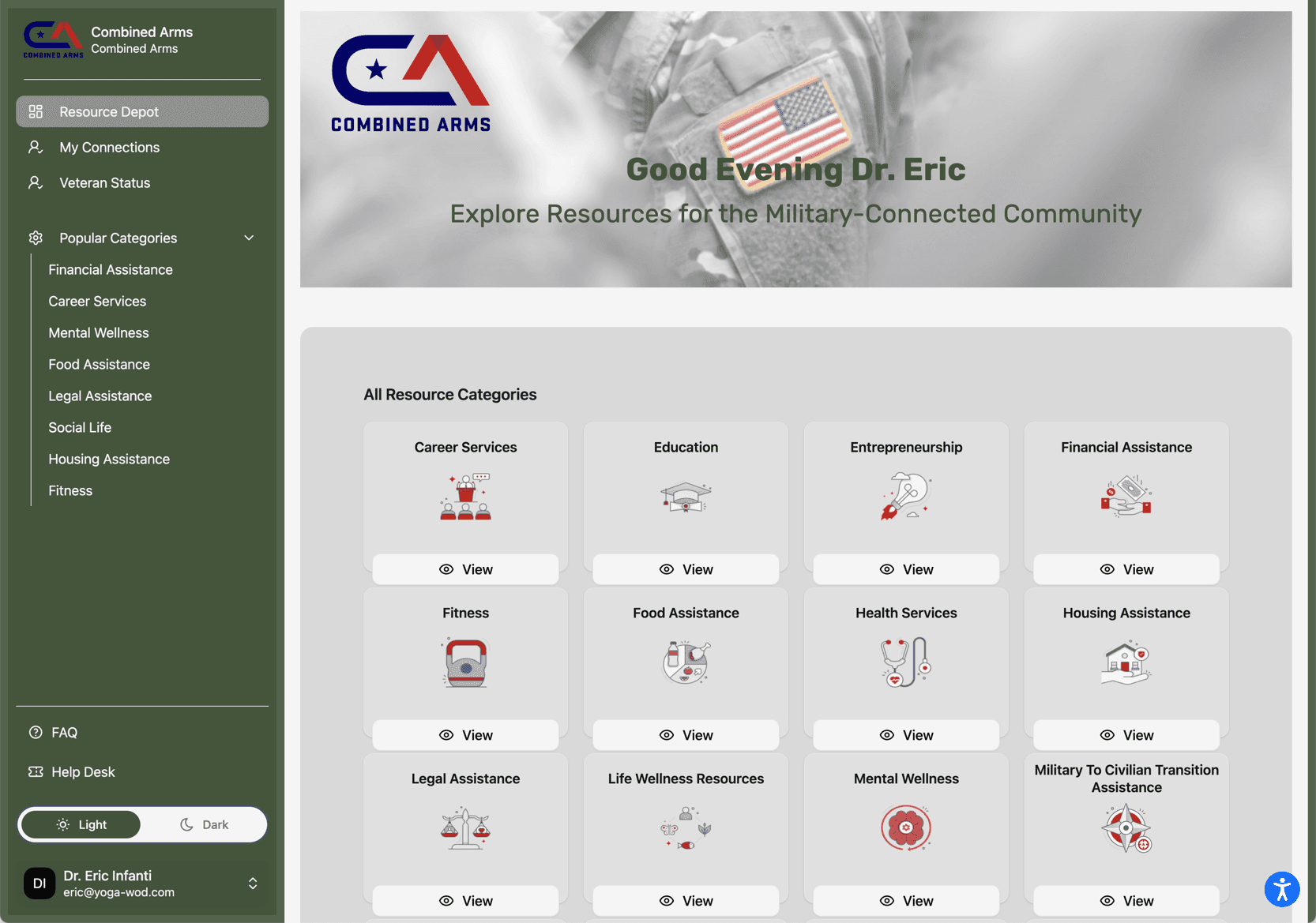
The redesign introduced a more structured and intuitive experience architecture for the Veteran Portal. I focused on creating clearer navigation patterns, stronger visual hierarchy, simplified workflows, and a more coherent path to action across the experience.
Rather than treating the redesign as a cosmetic update, I approached it as an opportunity to improve usability at the system level. Each design decision was intended to reduce effort, improve comprehension, and help users move forward with greater confidence.
Reorganized navigation around primary user needs
Simplified page structure to improve scanability
Clarified action hierarchy and next steps
Applied more consistent interaction patterns across workflows
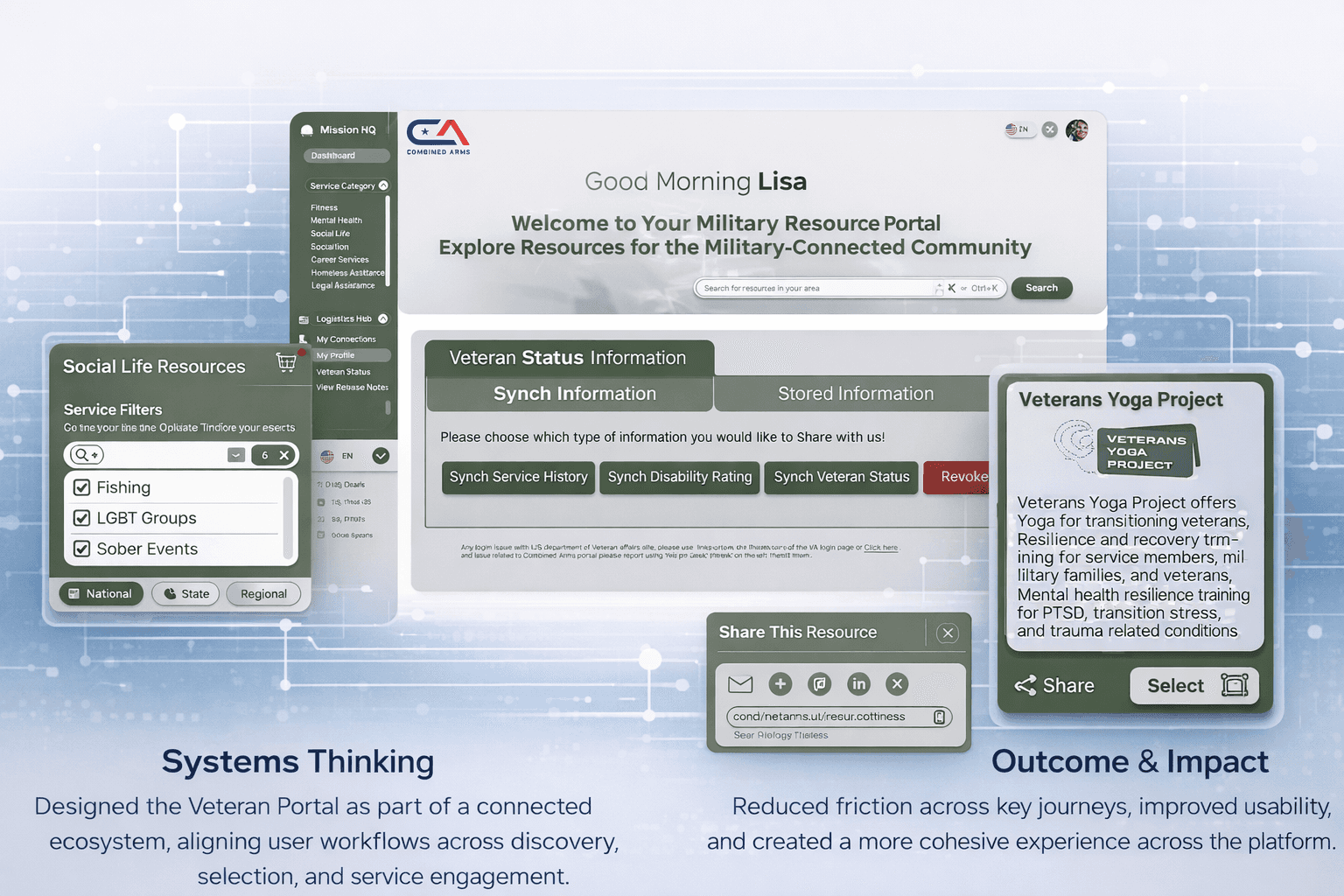
Systems Thinking
Designing the Veteran Portal as part of an ecosystem
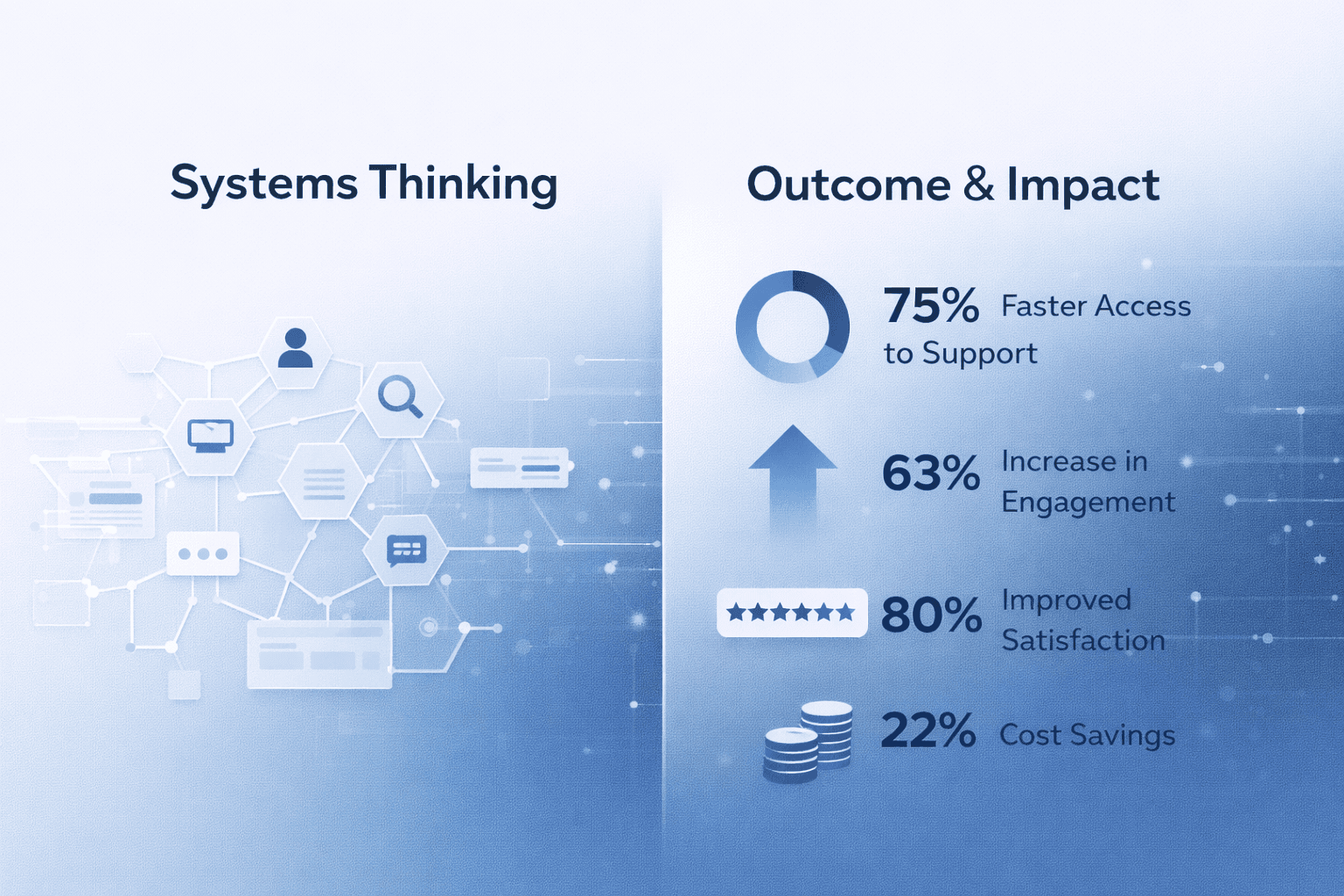
One of the most important aspects of this work was recognizing that the Veteran Portal could not be improved in isolation. It had to function coherently alongside partner and administrative experiences, each with their own workflows, constraints, and dependencies.
That required system-level alignment: making sure design patterns, terminology, logic, and service pathways worked together across the ecosystem. This approach helped move the work beyond interface redesign and into experience architecture.
Outcome & Impact
A more usable experience with stronger alignment across the platform
The redesign produced a clearer, more navigable veteran experience and helped establish a stronger UX foundation across the larger platform ecosystem. By reducing friction, improving structure, and aligning the portal more closely with user needs, the work supported better engagement and a more effective service experience.
Reduced friction across key user journeys
Improved clarity and usability of core workflows
Strengthened consistency across the broader platform ecosystem
Created a stronger foundation for future UX and CX improvements
Contributed to a measurable reduction in veteran user bounce rate
Improved project and workflow efficiency through clearer UX structure
Contraints & Tradeoffs
The redesign was shaped by several real-world constraints, including legacy system dependencies, evolving AWS migration requirements, and the need to maintain continuity for existing users.
These constraints required balancing ideal UX improvements with technical feasibility and phased implementation.
Several design decisions required careful tradeoffs. In some cases, simplifying workflows meant limiting flexibility. In others, maintaining familiarity for existing users required evolving patterns rather than replacing them entirely.
These decisions were guided by prioritizing clarity, usability, and long-term system consistency.
Looking Ahead…
Where I would take the experience next
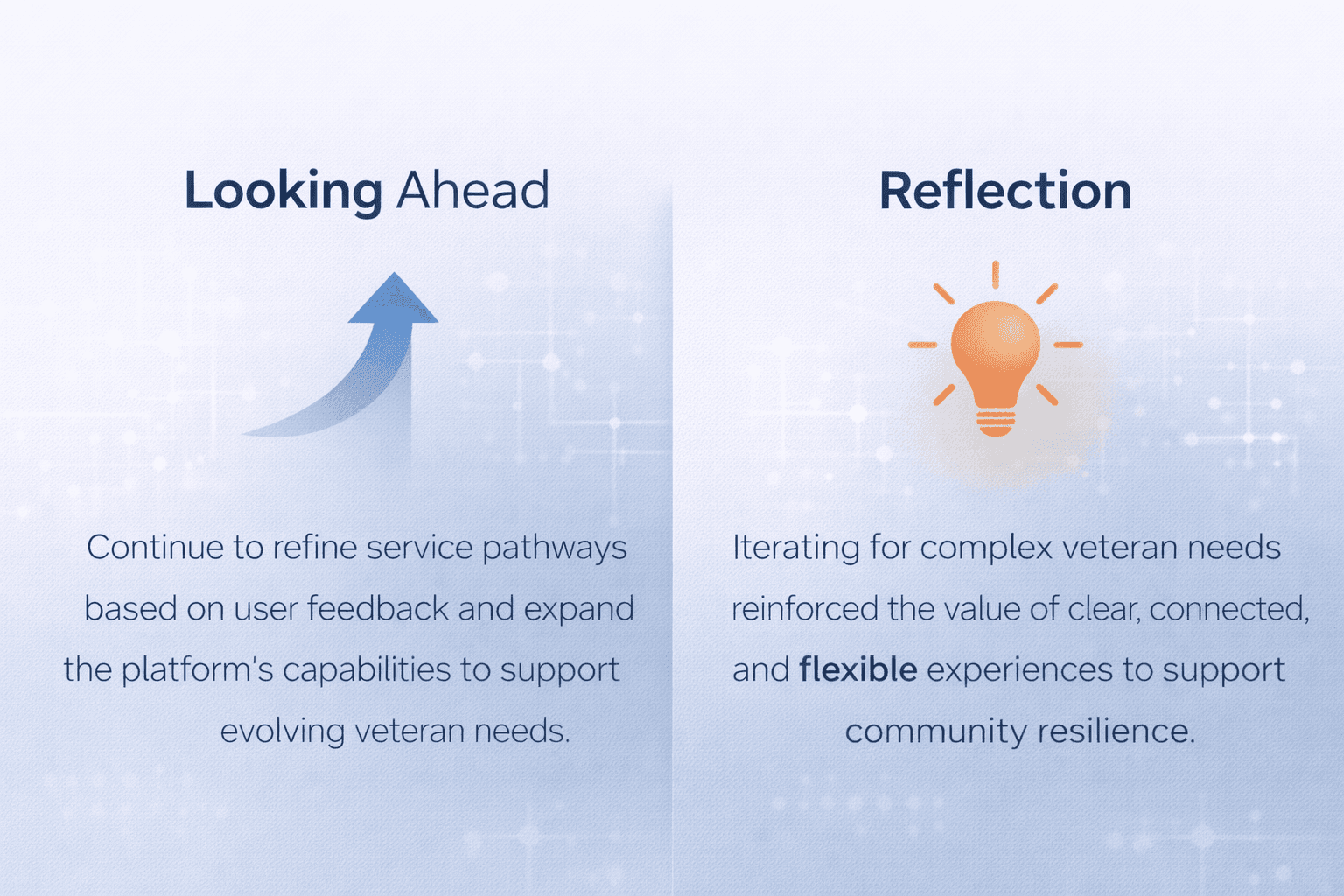
Given additional time and product support, the next phase would focus on deeper service personalization, stronger measurement of user task success, and tighter integration between veteran-facing workflows and backend support operations. I would also expand validation through continued usability testing and behavioral analysis to sharpen the experience over time.
Reflection
What this project reinforced
This project reinforced a principle that continues to define my work: in high-stakes systems, good UX is not about making interfaces look cleaner. It is about reducing friction where it matters most, helping people move forward with clarity, and designing systems that better support both human needs and organizational goals.
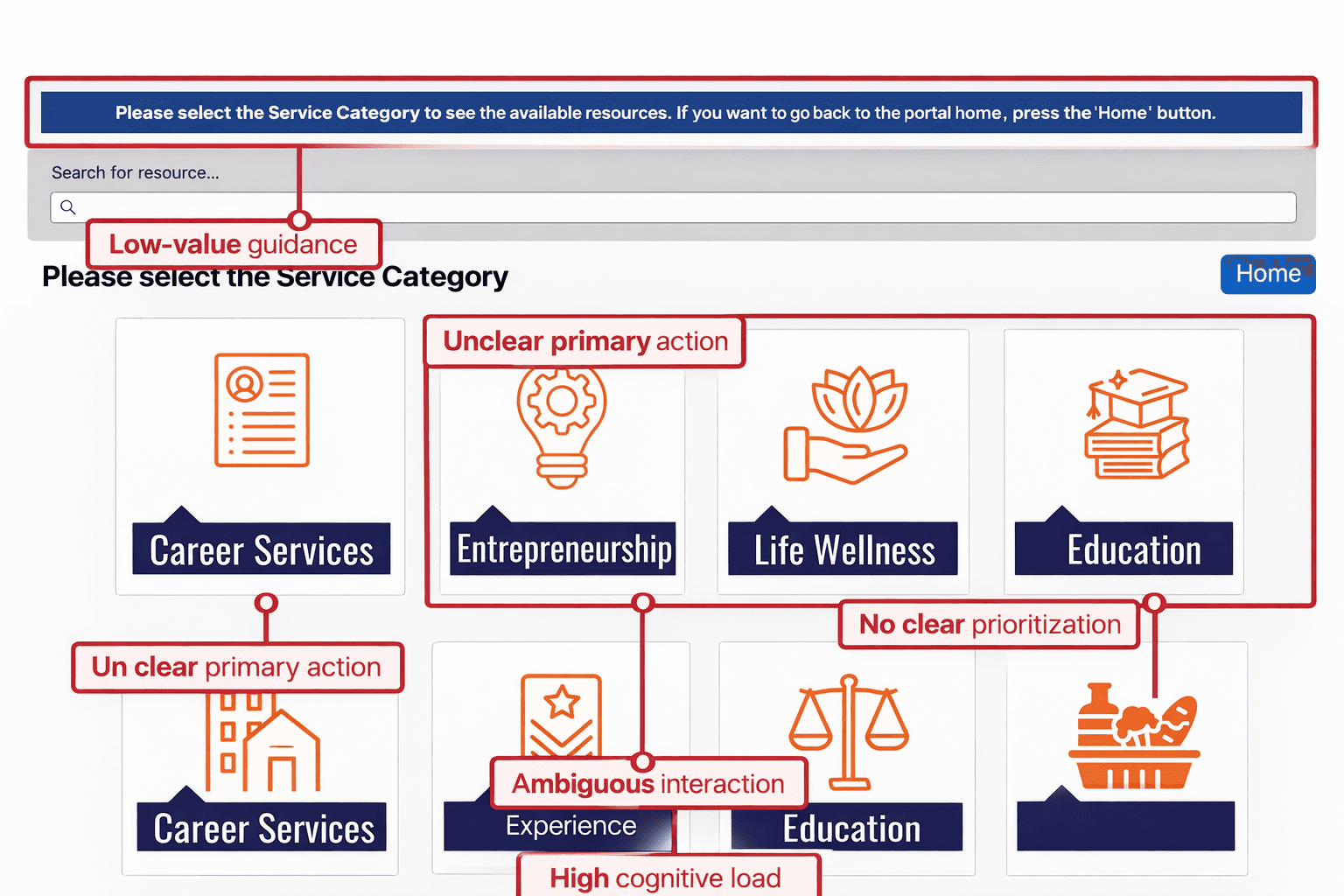
Before
Unclear entry points and competing options made it difficult for users to know where to begin.
After
A structured, guided experience with clear actions and improved hierarchy makes it easier for users to confidently get started.

5%
Reduction in veteran
user bounce rate
15%
Faster project and workflow turnaround
3 ⇾ 1
Unified fragmented portals into a single experience ecosystem
8+
Cross-functional team aligned across UX, product, and engineering
Metrics reflect a combination of measured improvements and observed
operational outcomes following the redesign.